All lists
Source · LAD
Top 100 Big History
100 items · 2026-06-07
- #1
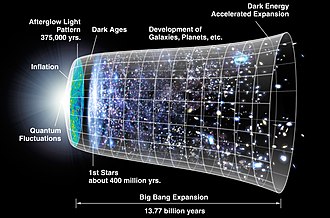 The Big BangThe origin of the universe, approximately 13.8 billion years ago
 - #2Formation of the First StarsFirst generation stars ignite from hydrogen and helium clouds, ~200 million years after the Big Bang
- #3Formation of the First GalaxiesGalaxies begin to coalesce from clouds of gas and early stars, ~1 billion years after Big Bang
- #4Stellar NucleosynthesisStars forge heavier elements from hydrogen and helium in their cores
- #5Death of First Stars (Supernovae)Massive first-generation stars explode as supernovae, seeding the cosmos with heavy elements
- #6
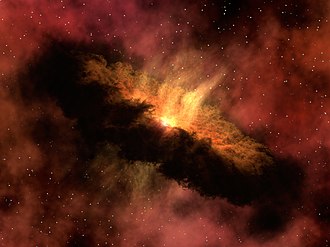 Formation of the Solar SystemOur Sun and planetary disk form from a collapsing molecular cloud, ~4.6 billion years ago
 - #7
 Formation of EarthEarth accretes from the solar nebula around 4.5 billion years ago
 - #8The Moon-Forming Impact (Theia)A Mars-sized body collides with early Earth, ejecting debris that forms the Moon
- #9Formation of Earth's OceansWater delivered by comets and asteroids pools on Earth's cooling surface ~4 billion years ago
- #10Origin of Life (Abiogenesis)First self-replicating molecules emerge in Earth's oceans ~3.8–4 billion years ago
- #11First Prokaryotic CellsSimple single-celled organisms without nuclei appear ~3.5 billion years ago
- #12Photosynthesis EvolvesCyanobacteria begin producing oxygen via photosynthesis ~2.7 billion years ago
- #13The Great Oxidation EventOxygen floods Earth's atmosphere ~2.4 billion years ago, transforming all life
- #14First Eukaryotic CellsComplex cells with nuclei emerge ~2 billion years ago, possibly via endosymbiosis
- #15Multicellular Life EmergesFirst multicellular organisms appear ~1.2 billion years ago
- #16
 Snowball EarthEarth nearly entirely freezes over multiple times between 850–635 million years ago
 - #17Cambrian ExplosionRapid diversification of complex animal life ~541 million years ago
- #18Plants Colonize LandFirst plants move onto land ~470 million years ago
- #19First InsectsInsects evolve on land ~400 million years ago, becoming the most diverse animal group
- #20First Vertebrates on Land (Tetrapods)Fish evolve limbs and lungs, crawling onto land ~375 million years ago
- #21Permian Mass ExtinctionThe Great Dying kills ~96% of marine species ~252 million years ago
- #22Rise of DinosaursDinosaurs emerge as dominant land vertebrates ~230 million years ago
- #23First MammalsSmall, warm-blooded mammals evolve from synapsids ~225 million years ago
- #24First Flowering Plants (Angiosperms)Flowering plants appear ~130 million years ago, revolutionising ecosystems
- #25Chicxulub Asteroid ImpactA massive asteroid strikes Earth ~66 million years ago, ending the dinosaurs
- #26Rise of MammalsWith dinosaurs gone, mammals diversify explosively into all niches
- #27Primate EvolutionPrimates emerge and diversify ~55 million years ago
- #28Great Ape Lineage DivergesApes and Old World monkeys split ~25 million years ago
- #29Human-Chimp DivergenceHuman and chimpanzee lineages separate ~6–7 million years ago
- #30Bipedalism Evolves (Australopithecus)Early hominins begin walking upright ~4 million years ago
- #31First Homo GenusHomo habilis appears ~2.8 million years ago with larger brains and stone tools
- #32Oldowan Stone ToolsFirst stone tool technology ~2.6 million years ago — humanity's first technology
- #33Ice Ages BeginGlacial cycles intensify ~2.6 million years ago, shaping human evolution
- #34Homo erectus EmergesHomo erectus evolves ~1.9 million years ago with larger brains and Acheulean tools
- #35Control of FireEarly humans learn to control fire ~1 million years ago, transforming diet and society
- #36Out of Africa I (Homo erectus)Homo erectus spreads from Africa into Eurasia ~1.8 million years ago
- #37Neanderthals EvolveNeanderthals emerge in Europe and western Asia ~400,000 years ago
- #38Origin of Homo sapiensAnatomically modern humans evolve in Africa ~300,000 years ago
- #39Symbolic Thinking and LanguageEvidence of complex language, art, and symbolic thought emerges ~100,000–70,000 years ago
- #40
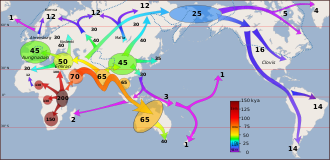
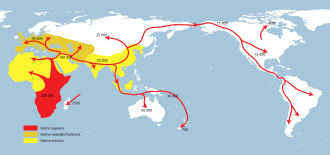 Out of Africa IIModern humans migrate out of Africa ~70,000 years ago, colonising the world
 - #41Crossing into AustraliaHumans reach Australia ~65,000 years ago via island-hopping
- #42Cave Art and Ochre PaintingsSpectacular cave paintings at Lascaux, Chauvet, and Altamira ~40,000–17,000 years ago
- #43Crossing the Bering Land BridgeHumans enter the Americas across Beringia ~16,000–13,000 years ago
- #44Megafaunal ExtinctionMass extinction of large mammals (mammoths, ground sloths) coincides with human arrival
- #45End of the Last Ice AgeIce sheets retreat ~11,700 years ago, reshaping continents and climate
- #46Agricultural Revolution (Fertile Crescent)Humans begin farming wheat and barley in the Fertile Crescent ~10,000 BCE
- #47Domestication of AnimalsDogs, cattle, sheep, pigs and horses are domesticated ~10,000–5,000 BCE
- #48First Permanent SettlementsGöbekli Tepe and Jericho show organised permanent settlements ~10,000 BCE
- #49Invention of PotteryCeramic pottery revolutionises food storage and trade ~9,000–7,000 BCE
- #50Rise of Mesopotamian CitiesUruk and Eridu become the world's first cities ~4,000–3,500 BCE
- #51Invention of Writing (Cuneiform)Sumerians develop cuneiform script ~3,400 BCE — the birth of recorded history
- #52Bronze Age BeginsCopper-tin alloy (bronze) transforms tools and warfare ~3,300 BCE
- #53Invention of the WheelWheeled vehicles appear in Mesopotamia ~3,500 BCE
- #54
 Pyramids of GizaAncient Egyptians build the Great Pyramid ~2,560 BCE — engineering marvel of the ancient world
 - #55
 Indus Valley CivilisationSophisticated urban civilisation with sewage systems at Mohenjo-daro ~2,600 BCE
 - #56
 Code of HammurabiFirst major written legal code established ~1,754 BCE in Babylon
 - #57Iron Age BeginsIron smelting spreads across Eurasia ~1,200 BCE, superseding bronze
- #58Invention of the AlphabetPhoenicians develop a consonant alphabet ~1,050 BCE that ancestors all modern alphabets
- #59Axial Age (Buddha, Confucius, Socrates)Major philosophical and religious traditions emerge simultaneously ~800–200 BCE
- #60
 Persian EmpireCyrus the Great builds the first true multicultural empire ~550 BCE
 - #61Classical Greece and DemocracyAthens develops democracy, philosophy, and science ~500–323 BCE
- #62
 Conquests of Alexander the GreatAlexander spreads Greek culture from Egypt to India ~336–323 BCE
 - #63Rise of the Roman Republic and EmpireRome expands to control the Mediterranean world ~509 BCE–476 CE
- #64Invention of CoinageLydia mints the first standardised coins ~600 BCE, enabling complex commerce
- #65Silk Road EstablishedTrade routes connecting China to Rome and India open ~130 BCE
- #66
 Rise of ChristianityChristianity emerges in Roman Judea and spreads across the empire ~30–300 CE
 - #67
 Fall of the Western Roman EmpireRome falls to Germanic tribes in 476 CE, beginning the European Middle Ages
 - #68Rise of IslamMuhammad founds Islam ~610 CE; Islamic civilisation becomes a world power
- #69Tang and Song Dynasty ChinaChina leads the world in science, trade, and culture ~618–1279 CE
- #70Viking Age and ExplorationNorse seafarers explore and settle from Greenland to North America ~793–1066 CE
- #71
 Mongol EmpireGenghis Khan builds the largest contiguous land empire in history ~1206–1368 CE
 - #72Black Death PandemicBubonic plague kills ~75 million people across Eurasia ~1347–1351 CE
- #73Gutenberg's Printing PressMoveable type printing democratises knowledge ~1440 CE
- #74Columbus Reaches the AmericasEuropean contact with the Americas in 1492 begins the Columbian Exchange
- #75
 Columbian ExchangeGlobal transfer of crops, animals, people, and diseases reshapes civilisations ~1492–1600
 - #76
 Scientific RevolutionCopernicus, Galileo, and Newton transform humanity's understanding of the cosmos ~1543–1687
 - #77
 Atlantic Slave Trade~12 million Africans forcibly transported to the Americas ~1500–1800
 - #78
 Industrial RevolutionSteam power and mechanisation transform production and society in Britain ~1760–1840
 - #79American and French RevolutionsDemocratic ideals overthrow monarchies and reshape governance ~1776–1789
- #80
 Abolition of SlaverySlave trade abolished in Britain 1807; US emancipation 1865; global movement spreads
 - #81
 Germ Theory of DiseasePasteur and Koch prove microorganisms cause disease ~1860–1880
 - #82Darwin's Theory of EvolutionOn the Origin of Species published 1859, unifying all of biology
- #83
 First World WarIndustrial-scale warfare kills ~20 million ~1914–1918, reshaping global order
 - #84Russian RevolutionBolsheviks seize power in 1917, launching the Soviet experiment
- #85Second World War and the HolocaustGlobal conflict kills ~70–85 million, including systematic genocide of 6 million Jews ~1939–1945
- #86Atomic Bomb and Nuclear AgeFirst nuclear weapons detonated 1945 — humanity gains existential destructive power
- #87Discovery of DNA Double HelixWatson, Crick, Franklin and Wilkins reveal life's code in 1953
- #88DecolonisationDozens of nations win independence from European empires ~1945–1975
- #89Green RevolutionHigh-yield crops and fertilisers dramatically increase food production ~1960s–1980s
- #90Space Age Begins (Sputnik, Moon Landing)Humanity leaves Earth: Sputnik 1957, Moon landing 1969
- #91
 Invention of the InternetARPANET evolves into the global internet ~1969–1991, connecting all humanity
 - #92
 Human Genome ProjectFirst complete map of the human genome published 2003
 - #93Rise of China as Global PowerChina's economic reforms from 1978 lift 800 million out of poverty and reshape geopolitics
- #94Climate Change RecognitionScientific consensus on human-caused global warming emerges ~1988–2000s
- #95World Wide Web and Digital RevolutionTim Berners-Lee invents the Web in 1991; smartphones and social media transform society
- #96
 GlobalisationTrade, migration, and cultural exchange reach unprecedented scale ~1990s–present
 - #97Mapping the Human BrainNeuroscience and AI combine to begin mapping the connectome — understanding consciousness
- #98CRISPR Gene EditingCRISPR-Cas9 enables precise gene editing ~2012, opening an era of biological redesign
- #99Artificial Intelligence RevolutionDeep learning and large language models transform every field ~2012–present
- #100
 The AnthropoceneHumanity becomes a geological force shaping Earth's climate, biosphere, and future